
AI vs Machine Learning: What's the Difference and Why Nexton Teaches Them Together
Nexton Editorial Team
Published on Sep 08, 2026

If you have compared AI and ML courses online, you have probably found two different explanations of what each term means, with no clear answer on which one to study first. The truth is simpler than most guides make it sound. Artificial intelligence is the broader goal, and machine learning is the method most modern systems use to reach it. Understanding both together is exactly why Nexton Learning built its AI and Machine Learning program as one integrated course rather than two separate tracks, a decision that maps directly to how employers actually hire.
Key Takeaways
- AI is the broader science of building machines that reason and make decisions, while machine learning is the data driven method that powers most modern AI systems.
- Employers rarely hire someone who understands artificial intelligence & machine learning as separate subjects; they hire people who can apply both together on real projects.
- Nexton teaches AI with machine learning in a single 6 month hybrid curriculum, backed by Dual Mentor Support and NEXTON AI 24/7 doubt resolution.
What Does AI Actually Mean?
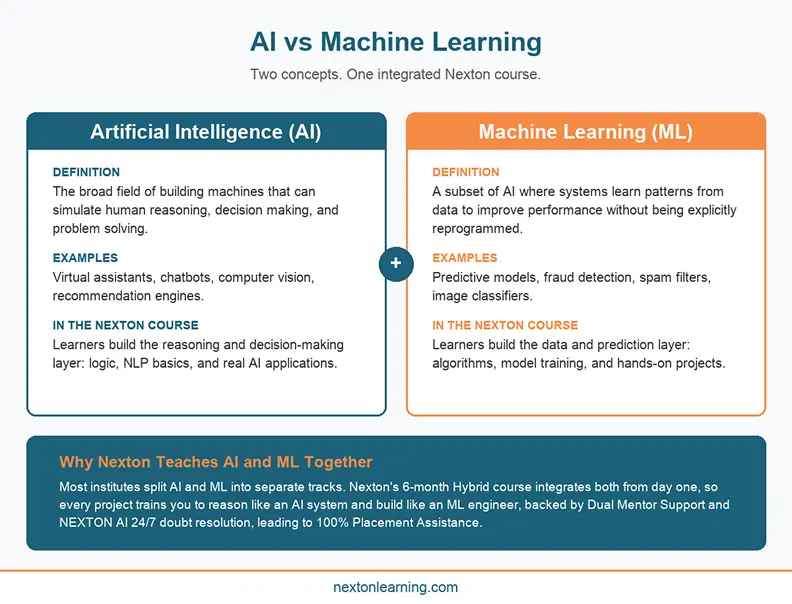
Artificial intelligence is the umbrella term for any system designed to perform tasks that normally require human intelligence: reasoning, planning, understanding language, or recognizing patterns. Google Cloud describes AI as technology that mimics human intelligence to perform tasks like problem solving, decision making, and recognizing patterns. That definition covers a huge range of tools, from simple rule based chatbots to advanced systems that write code or read medical scans.
For learners exploring AI and ML courses in Kerala, this breadth is often the biggest source of confusion. AI is not one skill, it is a goal. The methods used to reach that goal have changed dramatically over the past decade, and today, machine learning is the dominant method. Anyone serious about a career in this field needs to understand both the destination, AI, and the vehicle, ML, getting them there.
Think about a hiring manager reviewing resumes for an AI focused role. A candidate who can only describe AI in abstract terms, without ever having trained a model or worked with real data, rarely makes it past the first interview. The concept only becomes useful once you can point to a project where you applied it. That is the gap Nexton's course is built to close from the very first module, rather than leaving learners to bridge it on their own after graduation.
What Does Machine Learning Actually Mean?
Machine learning and AI are related, but they are not interchangeable terms. Machine learning is a subset of AI where systems improve at a task by learning patterns from data, rather than being manually programmed with a rule for every scenario. IBM describes machine learning as the subset of artificial intelligence focused on algorithms that learn from training data to make accurate predictions on new data. In practice, this means feeding a model thousands of examples, whether that is customer behaviour, medical images, or spoken language, and letting it identify the pattern itself.
This is the part most beginners skip. You cannot build a modern AI application without machine learning underneath it, and pairing machine learning with AI context from day one prevents that gap. Studying artificial intelligence & machine learning as two disconnected subjects is a bit like learning to drive without ever discussing where the car is going.
It also explains why so many self taught learners get stuck. They pick up a machine learning library, follow a tutorial, and can reproduce a working model, but they cannot explain why that model was the right choice for the problem in the first place. That reasoning step belongs to AI, not machine learning, and skipping it is exactly what leaves candidates unable to answer basic interview questions about their own projects.
The Real Difference, and Why It Matters for Your Career
So what is the real difference? Artificial intelligence is the discipline; machine learning is the technique. AI includes machine learning, but also rule based expert systems, robotics, and natural language processing methods that do not always rely on data driven learning. Machine learning, on the other hand, is almost always built to serve an AI application, whether that is a recommendation engine, a fraud detection system, or a voice assistant.
For job seekers, this distinction is not academic. Recruiters searching for candidates who understand ai with machine learning are looking for people who can move fluidly between the two: someone who can reason about what a system should do, that is AI, and also build the model that makes it happen, that is ML. Employers rarely separate the two skill sets when writing a job description, so training that treats them as separate subjects leaves a gap exactly where the job market does not.
Look closely at a typical job posting for an AI or ML role in Kerala and you will rarely see the two terms used in isolation. Postings ask for someone who can scope a problem the way an AI product team would, then build and validate the model the way a machine learning engineer would. Splitting that single expectation across two separate courses only means paying twice for a skill set employers already treat as one.
Why Nexton Teaches AI and ML as One Integrated Course
Most training institutes still offer AI and ML courses as two separate certificates, forcing learners to pick one or pay for both. Nexton took a different approach. The AI and Machine Learning course combines both disciplines into a single 6 month hybrid program, because that is how the skills are actually used on the job.
Every module in the curriculum pairs the conceptual side of AI, reasoning and decision logic, with the practical side of machine learning, data preparation and model training. You can see exactly how the modules are sequenced in the full course syllabus and curriculum breakdown, where AI concepts and ML techniques are taught side by side rather than as isolated units. This structure means learners graduate with the ability to explain machine learning with AI context, not just run code they do not fully understand, backed by Dual Mentor Support and government approved, internationally recognized certification.
Live projects follow the same integrated logic. Instead of a standalone AI assignment followed by an unrelated machine learning assignment, learners work through case studies that require both: defining what problem the system should solve, then building and testing the model that solves it. Industry mentors review both halves of the work together, so feedback always connects the reasoning behind a decision to the data that supports it, which is exactly how AI teams operate once you are on the job.
What This Integration Means for Your Career
The payoff of choosing AI and ML courses that teach both subjects together shows up fastest in placements. Employers hiring for AI related roles increasingly expect candidates to handle both the reasoning layer and the data layer of a project, and graduates who only know one half often lose out to those who know both. Nexton's integrated structure, combined with 100% Placement Assistance, is designed specifically to close that gap, and graduates who understand machine learning and AI together tend to interview with more confidence.
If you want a detailed look at the roles, salaries, and skills this integrated training opens up in Kerala, the breakdown of machine learning careers, job roles, and salaries after the Nexton course is a useful next read. It maps directly to what you build during the course itself, so the skills you practice in class are the same ones listed in the job descriptions you will apply to after graduation.
This is also where the placement cell becomes part of the learning path rather than an afterthought. Because every learner has already practiced explaining both the AI reasoning and the ML execution behind a project, mock interviews and resume reviews can focus on presenting that combined skill set clearly, instead of trying to patch together two half finished stories about separate coursework.
Conclusion
AI and machine learning are not competing subjects, they are two halves of one skill set, and separating them in a classroom only delays the moment you have to combine them on the job. Nexton built its AI and ML course around that reality, teaching AI and machine learning together from day one, supported by NEXTON AI 24/7 doubt resolution, Dual Mentor Support, and 100% Placement Assistance. If you are ready to learn both the reasoning and the technique behind modern AI systems, get in touch with our team to talk about the next batch and find the right starting point.